Industrial facilities, equipment manufacturers, and data center projects often require multiple steel components with identical dimensions. Whether producing mounting plates, brackets, or equipment frames, even small inconsistencies can create problems during assembly and installation.
Demand for these components may continue to grow as the Philippines explores new industrial developments. In May 2026, SMM Steel reported the Philippine Iron and Steel Institute’s observation that artificial intelligence-related infrastructure could increase domestic steel demand. The report also discussed an announced US-led initiative to develop a proposed 4,000-acre industrial hub supporting AI, semiconductor, and critical mineral supply chains. The hub remains a proposed development rather than a completed facility.
For contractors and manufacturers looking for laser cutting services in Manila, choosing the right provider means understanding material compatibility, dimensional accuracy, production requirements, and available fabrication support.
This guide explains the types of steel components used in industrial projects, how fiber laser cutting works, and what buyers should prepare when requesting a quotation.
What Kind of Metal Parts Do Industrial and Data Center Projects Need?
Industrial and data center projects commonly require fabricated steel plates and sheet components, including base plates, brackets, racks, cable supports, enclosures, and equipment frames. These parts support equipment installation, structural connections, cable organization, and protective assemblies.
The exact components depend on the facility design, equipment specifications, and engineering requirements.
| Steel component | Common application | Important fabrication requirement |
| Base plates | Mounting equipment and supporting structural connections | Accurate dimensions and hole placement |
| Brackets | Connecting or supporting equipment and accessories | Consistent shapes and mounting points |
| Racks and cable support | Organizing equipment, cables, and service routes | Proper alignment and connection spacing |
| Equipment enclosures | Protecting electrical and mechanical equipment | Accurately fitted panels and openings |
| Equipment frames | Supporting machinery and mounted components | Dimensional consistency and precise connections |
Why Dimensional Consistency Matters
Consider an industrial facility installing multiple identical equipment frames. Each frame may require several mounting plates with matching bolt holes.
If the hole positions differ between components, installation teams may need to rework the plates or adjust the assembly. This can increase labor requirements and delay equipment installation.
Three fabrication characteristics are particularly important:
- Dimensional accuracy: Components must match the measurements specified in approved drawings.
- Hole positioning: Mounting holes and connection points must align with mating components.
- Flatness: Plates and panels must meet the flatness requirements of their intended application.
Repeatability is important. When producing dozens or hundreds of identical parts, consistent cutting helps reduce fitting problems during assembly.
This is one reason manufacturers use precision metal cutting for components that require complex shapes or repeated dimensions.
Is Laser Cutting Accurate Enough for Equipment Frames?
Yes, fiber laser cutting is suitable for producing accurately shaped steel plates and sheet components used in equipment frames. However, achievable tolerances depend on material type, thickness, equipment capabilities, and the project’s dimensional requirements.
Fiber laser cutting uses a concentrated laser beam to cut metal along a programmed path. The process is commonly controlled through computer numerical control (CNC) equipment, allowing the machine to follow digital cutting instructions.
Advantages of Fiber Laser Cutting
For industrial steel components, fiber laser cutting offers several practical advantages.
- Accurate holes and contours: CNC-controlled cutting can produce detailed profiles and openings based on technical drawings.
- Consistent repeat production: Approved cutting programs can be reused for multiple components.
- Clean cutting edges: Properly configured equipment can produce edges that require less secondary processing, depending on the application.
- Flexible design changes: Digital cutting programs can accommodate different part shapes without requiring a dedicated physical cutting die for every design.
For example, a manufacturer producing equipment mounting brackets may need several variations with different hole patterns. Laser cutting allows these profiles to be prepared from digital drawings, subject to the machine’s capabilities.
What Are the Limitations of Laser Cutting?
Although laser cutting is versatile, it is not always the most appropriate fabrication method.
Very thick plates may exceed a machine’s cutting capacity or require alternative processing methods. The cutting process also introduces localized heat, which can affect edge characteristics and may require additional inspection or finishing.
For simple straight cuts, conventional shearing may be more economical depending on material thickness, production volume, and available equipment.
Laser cutting also produces flat components rather than complete welded assemblies. Equipment frames may still require bending, drilling, welding, machining, or other fabrication operations.
When comparing steel laser cutting services, buyers should confirm the supplier’s supported materials, thickness range, achievable tolerances, and secondary processing options.
For critical parts, request a sample or first-article inspection before full production.
How Do I Order Laser-Cut Plates in Manila?
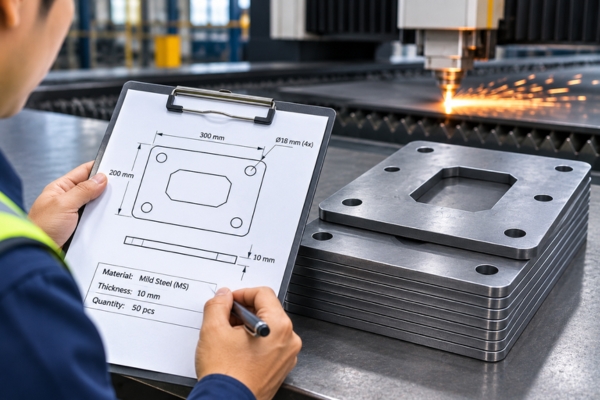
To order laser-cut plates, provide technical drawings, material specifications, thickness, quantity, and delivery requirements. The cutting provider can then evaluate whether the design is suitable for its equipment and prepare a quotation.
For businesses looking for metal laser cutting services, submitting complete requirements from the beginning helps reduce quotation revisions and production misunderstandings.
Laser Cutting Order Checklist
- Technical drawing: Submit a dimensioned drawing showing the required shapes, holes, cutouts, and tolerances. Confirm which digital file formats the supplier accepts.
- Material type and grade: Specify whether the project requires mild steel, stainless steel, galvanized steel, or another material. Include the applicable grade or standard.
- Material thickness: Indicate the required plate or sheet thickness in millimeters.
- Quantity: State how many pieces are required for each design, including any separate prototypes or sample pieces.
- Additional processing: Identify drilling, bending, welding, or finishing requirements that may need separate fabrication processes.
- Delivery requirements: Provide preferred completion date, location, and special handling instructions.
Get Industrial Steel Cutting and Fabrication Support from He-Max Industrial
Sourcing steel materials and fabrication services from one provider can simplify procurement by reducing the coordination required between separate material suppliers and processing workshops.
For example, a contractor purchasing steel plates from one company and arranging cutting through another must coordinate material availability, transport, processing schedules, and quality checks.
When these activities are handled through one supplier, it may be easier to align material specifications with fabrication requirements.
Steel Cutting and Fabrication Services
He-Max Industrial Corporation supplies steel products and provides fabrication services for construction, manufacturing, and industrial applications.
Its relevant services include:
- Fiber Laser Cutting: CNC-controlled cutting for custom steel components. He-Max lists a 12-kW fiber laser with a 6,100 × 2,500 mm work area, supporting mild steel, stainless steel, galvanized steel, and brass. Actual cutting thickness limits and tolerances should be confirmed for each material.
- Base Plate Cutting and Drilling: Preparation of customized mounting and connection plates based on project dimensions and hole requirements.
- Shearing and Bending: Processing of steel sheets and plates requiring straight cuts or formed sections.
Contractors can also explore He-Max’s steel plate products when sourcing materials for their fabrication requirements.
Combining material supply with cutting, drilling, and bending services can help project teams coordinate component preparation. However, buyers should still confirm processing compatibility, inspection requirements, and production schedules before ordering.
For companies evaluating industrial laser cutting services, the right provider should be able to review technical drawings, explain material limitations, and clarify the fabrication work included in its quotation.
Whether you need a small batch of mounting plates or repeated components for industrial equipment, selecting suitable laser cutting services in Manila starts with accurate specifications and clear communication.
Visit He-Max Industrial Corporation or contact the He-Max sales team to discuss your steel cutting requirements, submit project drawings, and request a quotation based on your material specifications and quantities.